
Table of Contents
- Why Celebrities Choose Hair Restoration
- How Modern Hair Transplants Have Changed
- What Celebrity Hair Transformations Teach Us
- Are Celebrity Hair Transplants Different?
- Should You Copy a Celebrity Hairline?
- Factors That Influence Hair Transplant Results
- What Makes a Hair Transplant Look Natural?
- Frequently Asked Questions
Hair loss affects millions of people worldwide including celebrities.
Because public figures spend much of their lives in front of cameras, changes in their appearance often attract significant attention. As a result, many people search online for information about celebrity hair transformations and wonder whether famous individuals undergo hair restoration procedures.
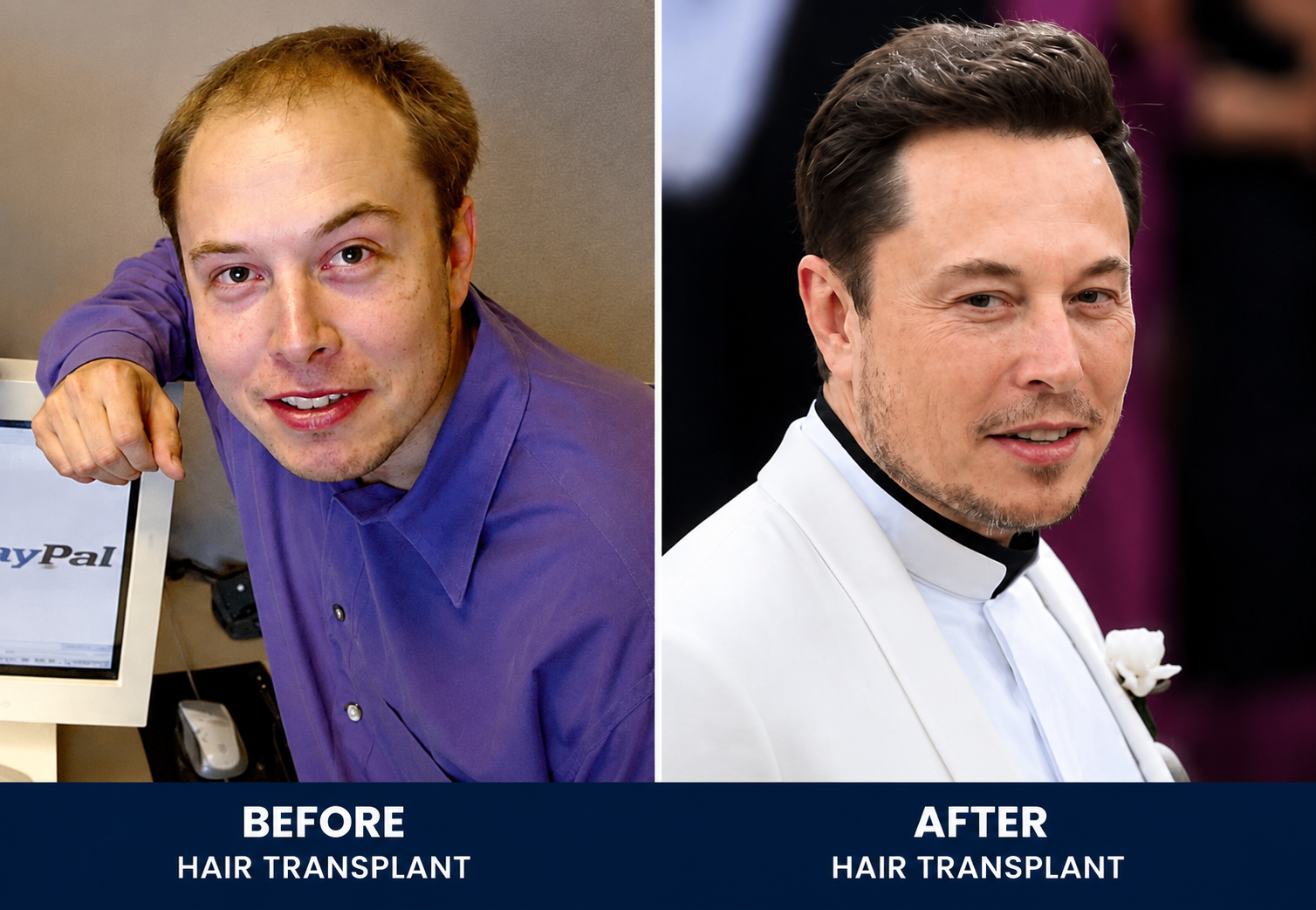
While not every visible hair transformation is necessarily the result of a hair transplant, celebrity hair changes have helped reduce stigma surrounding hair restoration and encouraged more people to seek treatment.
In this guide, we’ll explore why celebrities choose hair restoration, what modern hair transplant techniques can achieve, and what patients can learn from celebrity hair transformations.
Why Do Celebrities Consider Hair Restoration?
Appearance often plays an important role in industries such as entertainment, sports, television, and social media.
For many public figures, maintaining a youthful and confident appearance may be professionally important.
Hair restoration can help address concerns such as:
- Receding hairlines
- Temple recession
- Crown thinning
- Diffuse hair loss
- Age-related hair changes
Today, modern hair transplantation can create subtle, natural-looking improvements that are often difficult to detect.
How Have Modern Hair Transplants Changed?
In the past, hair transplantation sometimes produced unnatural results.
Older techniques often resulted in:
- Plug-like appearance
- Unnatural density
- Straight hairlines
- Visible scarring
Modern procedures such as FUE and DHI have transformed the field.
Advanced techniques now allow specialists to achieve:
- Natural-looking hairlines
- High-density results
- Minimal scarring
- Faster recovery
- Long-lasting outcomes
Because of these advances, many people—including public figures—choose hair restoration with confidence.
What Can We Learn From Celebrity Hair Transformations?
Celebrity hair transformations often demonstrate several important principles.
Early Treatment Produces Better Results
Many individuals seek treatment while significant native hair remains.
Early intervention often allows:
Better donor management
More natural outcomes
Preservation of existing hair
Reduced future graft requirements
Natural Hairlines Are Essential
One of the defining features of successful hair restoration is a natural-looking hairline.
Modern specialists design hairlines that:
Match facial proportions
Respect age
Age naturally over time
Blend with existing hair
Subtle improvements often produce the most convincing results.
Long-Term Planning Matters
Hair loss is progressive.
Successful restoration requires careful long-term planning to ensure results remain natural as patients age.
Are Celebrity Hair Transplants Different From Standard Procedures?
Not necessarily.
Celebrities typically have access to experienced medical teams and personalized treatment planning, but the same modern techniques are available to all patients.
Procedures commonly used include:
- FUE Hair Transplant
- DHI Hair Transplant
- PRP Therapy
- Exosome Therapy
- Preventive medical treatments
The key factor is choosing an experienced clinic rather than attempting to replicate another person’s exact hairline.
Should You Copy a Celebrity Hairline?
Not always.
Every patient has unique:
- Facial proportions
- Hair characteristics
- Donor area capacity
- Hair loss pattern
- Long-term goals
A hairline that suits one person may not suit another.
Instead of copying a celebrity exactly, patients should focus on achieving a natural result that complements their own facial structure.
Factors That Influence Hair Transplant Results
Several factors determine the success of any hair restoration procedure:
Donor Area Quality
Strong donor density is essential for achieving optimal coverage.
Hair Characteristics
Hair thickness, curl pattern, and color contrast significantly influence visual density.
Surgeon Experience
Natural hairline design, graft handling, and long-term planning are critical.
Patient Expectations
Realistic expectations contribute greatly to overall satisfaction.
What Makes a Hair Transplant Look Natural?
The most successful hair transplants typically feature:
- Age-appropriate hairlines
- Soft transitions
- Natural density gradients
- Proper graft angulation
- Balanced facial framing
Natural-looking results are often difficult to detect—even at close range.
Celebrity Hair Transplants: Final Thoughts
Celebrity hair transformations have helped normalize conversations about hair loss and hair restoration.
Modern hair transplantation can produce subtle, natural-looking results for suitable candidates.
However, successful treatment is highly individualized.
Rather than attempting to replicate a celebrity’s appearance, patients should focus on personalized treatment planning designed around their own facial features, donor capacity, and long-term goals.
Consulting an experienced hair restoration specialist remains the best way to achieve natural and lasting results.
Frequently Asked Questions
Do celebrities get hair transplants?
Some public figures have openly discussed undergoing hair restoration procedures, while others have never confirmed treatment.
Can modern hair transplants look natural?
Yes. Modern techniques such as FUE and DHI can create highly natural-looking results.
Should I copy a celebrity hairline?
Not necessarily. Hairline design should always be personalized.
What technique do celebrities usually choose?
Both FUE and DHI are commonly used because they can provide natural results with minimal visible scarring.
Can anyone achieve celebrity-level results?
Many patients can achieve excellent outcomes when treated by experienced specialists and when realistic expectations are maintained.
Medical Disclaimer
This article is intended for educational purposes only and should not replace professional medical advice. Hair transplant outcomes, longevity, and long-term maintenance vary depending on individual factors such as genetics, donor hair quality, age, overall health, and ongoing hair loss progression. Always consult a qualified hair restoration specialist for a personalized evaluation and treatment plan.
Medical Sources & References
- International Society of Hair Restoration Surgery (ISHRS)
Hair Restoration Patient Resources
https://ishrs.org - American Hair Loss Association (AHLA)
Hair Loss & Hair Transplant Information
https://www.americanhairloss.org - American Academy of Dermatology (AAD)
Hair Loss: Diagnosis and Treatment
https://www.aad.org - National Health Service (NHS)
Hair Loss Overview
https://www.nhs.uk - European Hair Research Society (EHRS)
Hair Research and Clinical Guidance
https://ehrs.org