High-Density Hair Restoration with DHI
Direct Hair Implantation (DHI) is an advanced hair transplant technique that allows hair follicles to be implanted directly into the scalp using a specialized tool called the Choi Implanter Pen.
Unlike traditional implantation methods, DHI does not require recipient channels to be created before the grafts are placed. Instead, each follicle is implanted individually with greater precision, allowing your surgeon to better control the angle, direction, and depth of every graft.
This high level of accuracy makes DHI an excellent choice for creating natural-looking hairlines, increasing hair density, and achieving seamless, long-lasting results.
How Does DHI Hair Transplant Work?
Every DHI procedure is individually planned to create a balanced hairline, maximize graft survival, and achieve long-lasting, natural results.
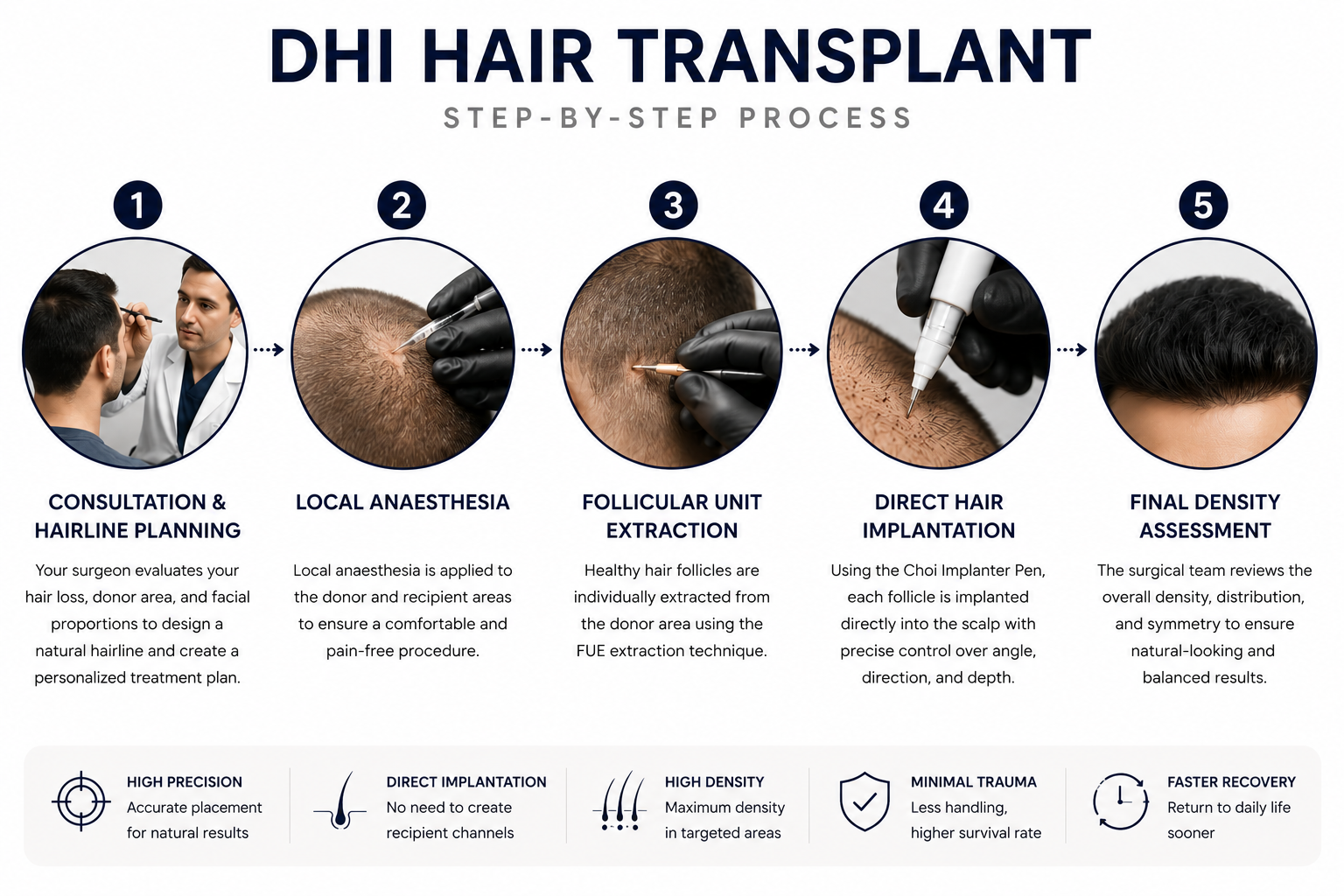
The treatment typically consists of five carefully performed stages.
1. Consultation & Hairline Design
The procedure begins with a detailed consultation where your surgeon evaluates your hair loss pattern, donor area, hair characteristics, and future hair loss progression. A personalized treatment plan is then created to achieve a natural hairline that complements your facial proportions.
2. Local Anaesthesia
Local anaesthesia is applied to both the donor and recipient areas, ensuring a comfortable procedure with minimal discomfort while the patient remains awake throughout the treatment.
3. Follicular Unit Extraction
Healthy follicular units are individually extracted from the donor area using the FUE extraction technique. Each graft is carefully inspected and preserved under optimal conditions before implantation to maximize survival.
4. Direct Hair Implantation
Using the Choi Implanter Pen, each follicle is implanted directly into the recipient area without creating channels beforehand. This allows the surgeon to precisely control the angle, depth, and direction of every graft while minimizing unnecessary handling.
5. Final Density Assessment
Once implantation is complete, the surgical team carefully evaluates graft distribution, density, and overall symmetry to ensure natural-looking coverage and balanced aesthetic results.
What Is the Choi Implanter Pen?
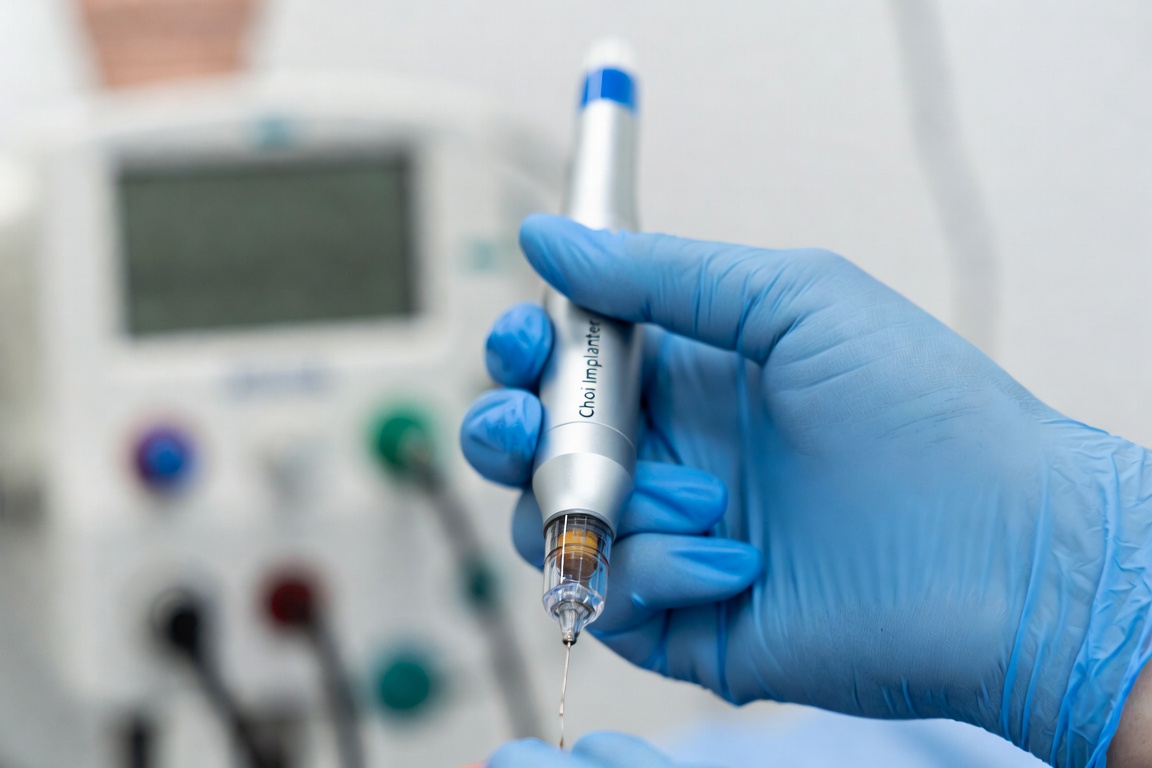
The Choi Implanter Pen is a specialized surgical instrument used exclusively during Direct Hair Implantation (DHI) procedures. It enables surgeons to implant individual hair follicles directly into the scalp without the need to create recipient channels beforehand.
The pen combines graft loading and implantation into a single controlled movement, reducing unnecessary graft handling while allowing highly accurate placement.
By providing greater control over the angle, direction, and depth of every implanted follicle, the Choi Implanter Pen plays a key role in creating natural hairlines, improving density, and achieving aesthetically refined results.
Although the instrument is an important part of the DHI technique, successful outcomes ultimately depend on the experience and expertise of the surgical team performing the procedure.
The Choi Implanter Pen is a specialized surgical instrument used exclusively during Direct Hair Implantation (DHI) procedures. It enables surgeons to implant individual hair follicles directly into the scalp without the need to create recipient channels beforehand.
The pen combines graft loading and implantation into a single controlled movement, reducing unnecessary graft handling while allowing highly accurate placement.
By providing greater control over the angle, direction, and depth of every implanted follicle, the Choi Implanter Pen plays a key role in creating natural hairlines, improving density, and achieving aesthetically refined results.
Although the instrument is an important part of the DHI technique, successful outcomes ultimately depend on the experience and expertise of the surgical team performing the procedure.
Why Is the Choi Implanter Pen Important?
The Choi Implanter Pen offers several advantages during the implantation stage of a DHI hair transplant.
Key Advantages
✔ Direct implantation without pre-opening channels
✔ Precise control of graft angle, direction, and depth
✔ Reduced graft handling
✔ High-density implantation
✔ Natural-looking hairline design
✔ Excellent precision in visible treatment areas
✔ Faster return to daily activities
✔ Long-lasting, natural-looking results
Who Is DHI Hair Transplant Best For?
DHI is particularly suitable for patients seeking precise implantation and higher density in visible treatment areas.
You may be a suitable candidate if you:
- Have early to moderate hair loss
- Want maximum density
- Need frontal hairline restoration
- Are considering female hair transplantation
- Have smaller treatment areas
- Prefer highly precise graft placement
Following your consultation, your surgeon will recommend whether DHI or FUE is the most appropriate treatment based on your donor area, hair characteristics, and restoration goals.
Why Choose DHI?
DHI is often preferred when precision is the highest priority. The ability to implant each follicle directly with the Choi Implanter Pen allows surgeons to carefully control every aspect of graft placement, making it particularly effective for creating refined hairlines and dense, natural-looking results.
Although DHI procedures may take longer than conventional implantation techniques, many patients choose this method because of its ability to deliver exceptional aesthetic outcomes in highly visible areas of the scalp.
Frequently Asked Questions
DHI is suitable for many men and women with early to moderate hair loss who have a healthy donor area. It is particularly recommended for patients seeking increased density or precise hairline restoration. A consultation will determine whether DHI is the most appropriate technique for your individual needs.
Both techniques use FUE to extract hair follicles from the donor area. The main difference is the implantation method. In DHI, each graft is implanted directly using the Choi Implanter Pen without creating recipient channels beforehand, allowing for greater precision and control during placement.
Yes. The transplanted follicles are typically taken from areas that are genetically resistant to hair loss. Once they establish themselves in their new location, they continue to grow naturally and can provide long-lasting, permanent results.
No. DHI is performed under local anesthesia, so the procedure itself is generally painless. Mild tenderness or discomfort may be experienced for a few days afterward but is usually well tolerated.
DHI does not create a linear scar. The tiny extraction and implantation sites usually heal quickly and become difficult to notice once the scalp has fully recovered.
The number of grafts depends on your donor area, hair loss pattern, and treatment goals. DHI is commonly used for smaller to medium-sized areas where precise graft placement and high density are the primary objectives.
Yes. DHI is one of the most popular hair transplant techniques for women because it allows highly precise implantation while preserving existing hair, making it an excellent option for increasing density without extensive shaving.
Temporary shedding during the first few weeks is a normal part of the healing process. New hair growth usually begins around 3–4 months, while the final results gradually develop over 12–18 months.
Most patients can return to their normal daily routine within a few days. Mild redness, slight swelling, and small scabs are common during the first week and typically resolve as the scalp heals.
Yes. DHI can be performed as a second hair transplant to improve density or restore additional areas affected by hair loss. Your surgeon will evaluate your donor hair availability, previous transplant results, and current goals to determine whether another procedure is appropriate.
