FUE Hair Transplant
Follicular Unit Extraction (FUE) is one of the most popular and widely used hair transplant techniques in the world. During the procedure, individual hair follicles are carefully taken from the donor area, usually the back or sides of the scalp, and transplanted into areas with hair loss.
Unlike older hair transplant methods, FUE does not require removing a strip of scalp. Instead, each hair follicle is extracted one by one using small, specialized tools. This helps reduce visible scarring, shortens recovery time, and provides natural-looking results.
FUE is suitable for both men and women and can restore hair in larger areas during a single session. Thanks to its reliable results and minimally invasive approach, it remains one of the most preferred options for permanent hair restoration.
How Does FUE Hair Transplant Work?
The FUE procedure is carefully planned to achieve natural hair growth, balanced density, and long-term results while protecting the donor area.
The treatment generally consists of five main stages:
1. Consultation & Hairline Design
Every procedure begins with a comprehensive consultation. Your surgeon evaluates your hair loss pattern, donor capacity, hair characteristics, and future hair loss progression before designing a personalized hairline that complements your facial proportions.
Local Anaesthesia
The donor and recipient areas are numbed using local anaesthesia to ensure a comfortable procedure. Patients remain awake throughout the treatment while experiencing minimal discomfort.
3. Follicular Unit Extraction
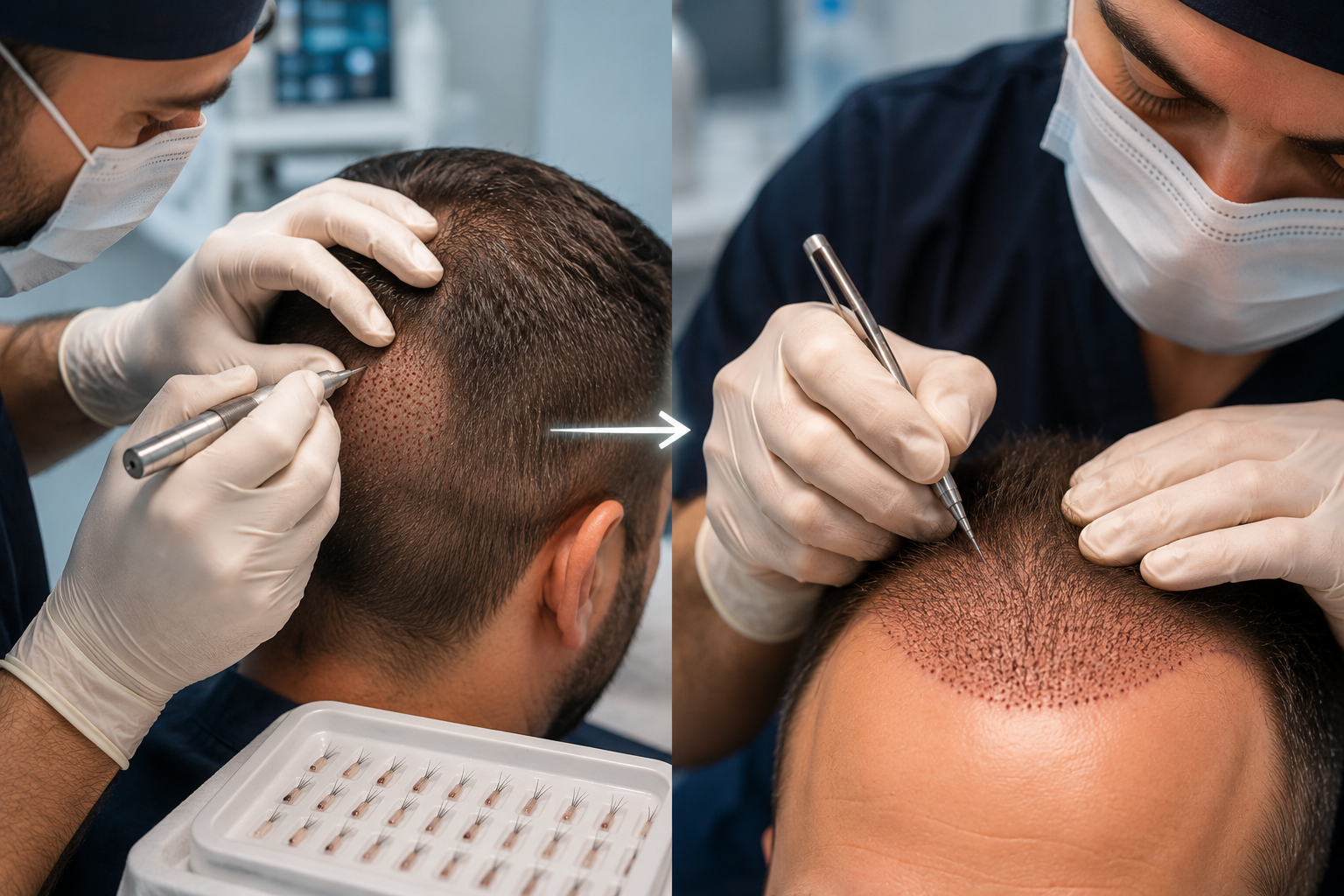
Healthy follicular units are carefully extracted one by one from the donor area using precision micro-punch instruments. Each graft is inspected and preserved under optimal conditions to maximize survival before implantation.
Recipient Site Creation
Tiny recipient channels are created according to the planned hairline design. The angle, direction, and depth of each incision are carefully adjusted to replicate the natural growth pattern of your existing hair.
Graft Implantation
The harvested follicles are meticulously implanted into the prepared recipient sites, creating natural density and seamless integration with existing hair. Every graft is positioned with precision to achieve balanced coverage and long-lasting aesthetic results.
Benefits of FUE Hair Transplant
FUE has become the preferred choice for millions of patients worldwide because it combines advanced surgical precision with natural-looking outcomes.
Key Benefits
✔ Minimally invasive procedure
✔ No linear scar
✔ Natural-looking hairline
✔ High graft survival rates
✔ Suitable for large graft sessions
✔ Faster recovery compared with older techniques
✔ Long-lasting, permanent results
✔ Effective for both frontal hairline and crown restoration
Who Is FUE Hair Transplant Best For?
FUE is suitable for a wide range of patients and is particularly recommended for individuals who require restoration over larger areas of hair loss.
You may be a suitable candidate if you:
- Have moderate to advanced hair loss
- Need full scalp or crown restoration
- Require 3,000–5,500 grafts
- Have a healthy donor area
- Want a minimally invasive procedure with natural-looking results
Following your consultation, your surgeon will determine whether FUE or another technique, such as DHI, is more appropriate for your specific hair restoration goals.
What Is Sapphire FUE?
Sapphire FUE is an advanced variation of the traditional FUE technique. While the follicle extraction process remains the same, the difference lies in how the recipient sites are created.
Instead of conventional steel blades, Sapphire FUE uses ultra-sharp sapphire blades to create tiny implantation channels. These blades allow for finer incisions and greater precision during graft placement while helping minimize tissue trauma.
Because of these characteristics, Sapphire FUE has become one of the most popular options in modern hair transplantation and is widely performed in Turkey.
Potential Advantages of Sapphire FUE
Compared with conventional FUE, Sapphire FUE may offer several additional benefits:
✔ Smaller and more precise recipient channels
✔ Reduced tissue trauma
✔ Faster healing process
✔ Less post-operative crusting
✔ Improved graft positioning
✔ Natural-looking density
✔ Comfortable recovery
FUE vs Sapphire FUE
Although both techniques use the same follicle extraction method, the main difference is the instrument used to create the recipient sites.
Feature | Standard FUE | Sapphire FUE |
Extraction Method | Individual follicle extraction | Individual follicle extraction |
Channel Creation | Steel blades | Sapphire blades |
Precision | High | Very High |
Tissue Trauma | Low | Potentially Lower |
Healing | Fast | May Be Faster |
Natural Results | Excellent | Excellent |
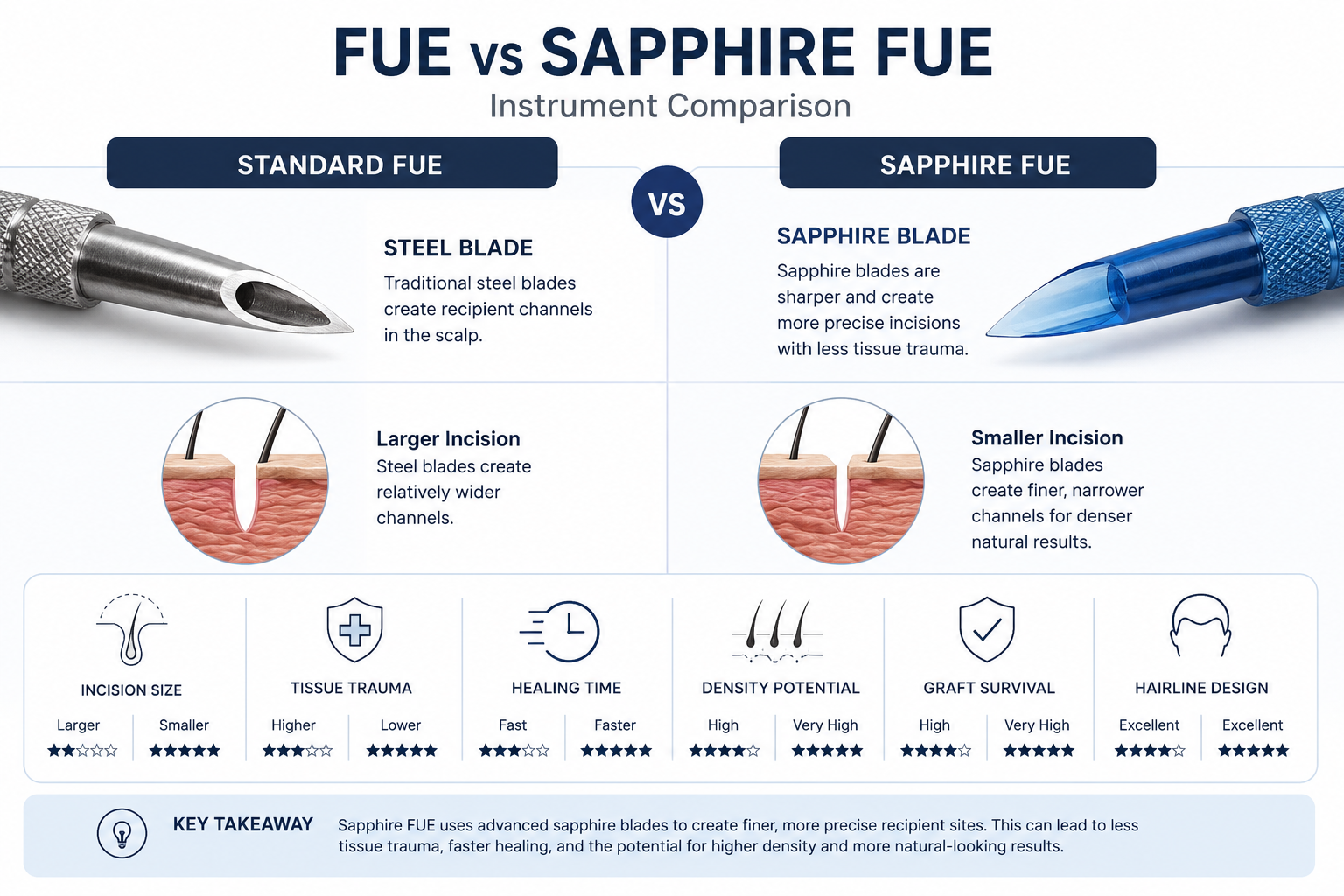
It’s important to note that Sapphire FUE is not a completely different hair transplant technique. Rather, it is a refinement of the FUE procedure that utilizes sapphire blades during channel creation to enhance surgical precision and support the healing process.
Who Is Sapphire FUE Best For?
Sapphire FUE may be recommended for patients who:
- Prefer advanced surgical technology
- Want highly precise graft placement
- Are suitable candidates for FUE
- Desire natural-looking density
- Wish to support a smooth recovery process
The final recommendation depends on your donor area, hair characteristics, and overall treatment goals, all of which are evaluated during your consultation.
Frequently Asked Questions
Yes. The transplanted hair follicles are usually taken from areas that are genetically resistant to hair loss. Once they grow in their new location, they continue to grow naturally and can provide long-lasting results.
No. FUE is performed under local anesthesia, so you should not feel pain during the procedure. Mild soreness or discomfort may occur for a few days afterward but is usually easy to manage.
No. FUE is suitable for both men and women experiencing hair loss, provided they have a healthy donor area and are considered good candidates by the surgeon.
FUE creates tiny circular extraction sites rather than a long linear scar. These small marks usually heal well and are difficult to notice, especially when the hair is kept at a normal length.
Most patients return to their normal daily routine within a few days. Small scabs usually fall off within 7–10 days, while the final results gradually develop over 12–18 months.
FUE has a high success rate when performed by an experienced medical team. The final outcome depends on factors such as donor hair quality, the number of grafts transplanted, and following the recommended aftercare instructions.
Neither technique is universally better. FUE is often preferred for covering larger areas, while DHI may provide greater precision for increasing density in smaller or more detailed areas. The best option depends on your hair loss pattern and treatment goals.
The number of grafts varies for each patient. Some people may need around 1,500 grafts for mild hair loss, while more advanced cases may require 3,000–4,500 grafts or more. A consultation is the best way to determine the right graft count.
Yes. Once the scalp has fully healed, you can cut or shave your transplanted hair just like your natural hair. Your surgeon will advise when it is safe to do so.
Most healthy adults with sufficient donor hair and stable hair loss are suitable candidates. Your eligibility is confirmed after a medical assessment and scalp examination.
