Ethnic Rhinoplasty
Ethnic rhinoplasty in Turkey is a specialized nose reshaping procedure. It improves the nose’s look and function while preserving each patient’s ethnic features.
Unlike conventional rhinoplasty, the goal is not a standard nose shape.
Instead, it aims for natural-looking improvements that fit the patient’s face and cultural background. Every procedure is carefully tailored according to skin thickness, cartilage strength, nasal anatomy, and individual aesthetic goals.
Turkey is a top destination for ethnic rhinoplasty. It offers skilled surgeons, advanced techniques, and personalized treatment plans for international patients.
- Ethnic Rhinoplasty in Turkey
- Quick Summary
- Popular Ethnic Rhinoplasty Combinations at Novera
- Who Can Benefit from Ethnic Rhinoplasty?
- What Is Ethnic Rhinoplasty?
- Why Ethnic Rhinoplasty Requires a Different Approach
- Ethnic Rhinoplasty by Ethnicity
- Ethnic Rhinoplasty Techniques
- Ethnic Rhinoplasty Recovery Timeline
- Ethnic Rhinoplasty Before and After Results
- Ethnic Rhinoplasty Cost in Turkey
- Frequently Asked Questions (FAQs)
Quick Summary
Ethnic rhinoplasty enhances the nose while preserving your natural ethnic features.
Treatment Attribute | Quick Details |
Procedure Focus | Structural refinement, bridge augmentation, or dorsal reduction without westernization |
Surgical Framework | Customized cartilage grafting (septum, rib, or ear) to build durable projection |
Anatomy Adaptations | Advanced techniques tailored for thicker facial skin and softer cartilage profiles |
Initial Recovery | 1 to 2 weeks (major swelling clears within the first month) |
Final Contours | Refinement continues up to 12-18 months due to unique skin thickness |
Popular Ethnic Rhinoplasty Combinations at Novera
When structurally reshaping an ethnic nose, achieving overall profile balance across the entire face is essential. Combining your nose surgery with these specialized surgical procedures under one anesthesia session yields highly integrated, stunning results:
1. The Ultimate Profile Alignment: Ethnic Rhinoplasty + Chin Liposuction
Many patients with African, Asian, or Hispanic heritage naturally possess softer lower-jaw projections or heavy genetic fat distribution under the chin. If a patient undergoes nose refinement while leaving a heavy “double chin” untreated, the facial profile will still appear unbalanced. Removing submental fat via Chin Liposuction while defining the nose bridge creates a remarkably straight, elegant, and red-carpet-ready jaw-to-neck profile.
2. The Exotic Eye Frame: Ethnic Rhinoplasty + Canthopexy (Cat Eyes)
Refining a flat nasal bridge or a wide nasal base shifts visual attention directly onto your eyes. Pairing an ethnic nose transformation with Canthopexy subtly lifts the outer corners of the eyes. This elegant combo brightens your entire mid-face, balancing the natural structural volume of ethnic skin with beautifully contoured, almond-shaped eye geometry.
Who Can Benefit from Ethnic Rhinoplasty?
Ethnic rhinoplasty is for patients who want to improve the look or function of their nose. It also helps keep the facial traits that make them unique.
It is commonly performed for patients of:
- African heritage
- Middle Eastern heritage
- Asian heritage
- Hispanic and Latin American heritage
- Mixed ethnic backgrounds
Every nose is different. That is why treatment planning focuses on your anatomy, not a one-size-fits-all approach.
What Is Ethnic Rhinoplasty?
Ethnic rhinoplasty is a customized rhinoplasty procedure that enhances nasal aesthetics while respecting each patient’s ethnicity and natural facial harmony.
Rather than changing your identity, the procedure refines your nose to look balanced, proportionate, and authentic.
Common goals include:
- Improving bridge definition
- Refining the nasal tip
- Reducing nostril width
- Improving projection
- Correcting asymmetry
- Enhancing breathing
- Preserving ethnic identity
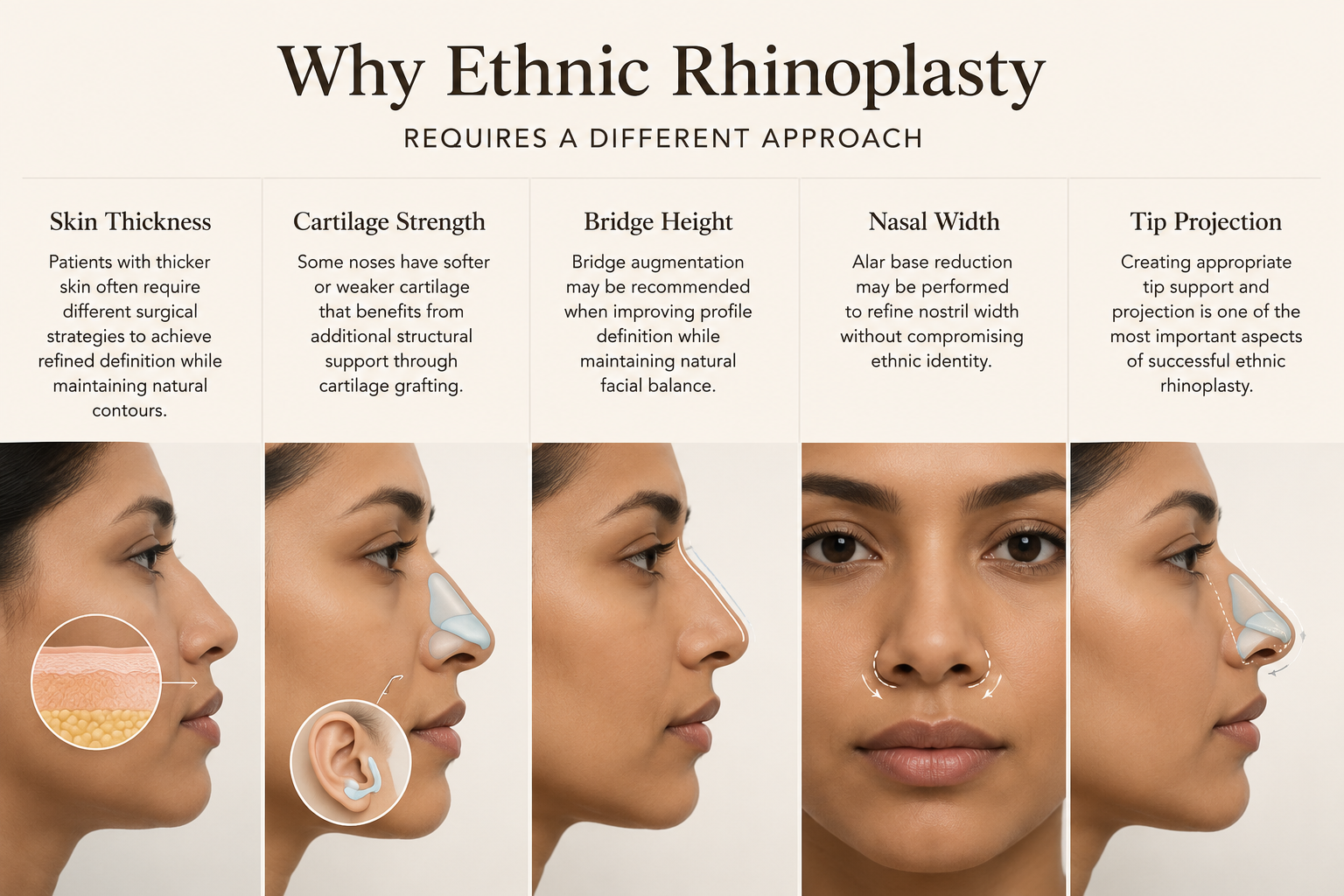
Why Ethnic Rhinoplasty Requires a Different Approach
Different ethnic groups often present unique anatomical characteristics that require specialized surgical planning.
Skin Thickness
Patients with thicker skin often require different surgical strategies to achieve refined definition while maintaining natural contours.
Cartilage Strength
Some noses have softer or weaker cartilage that benefits from additional structural support through cartilage grafting.
Bridge Height
Bridge augmentation may be recommended when improving profile definition while maintaining natural facial balance.
Nasal Width
Alar base reduction may be performed to refine nostril width without compromising ethnic identity.
Tip Projection
Creating appropriate tip support and projection is one of the most important aspects of successful ethnic rhinoplasty.
Ethnic Rhinoplasty by Ethnicity
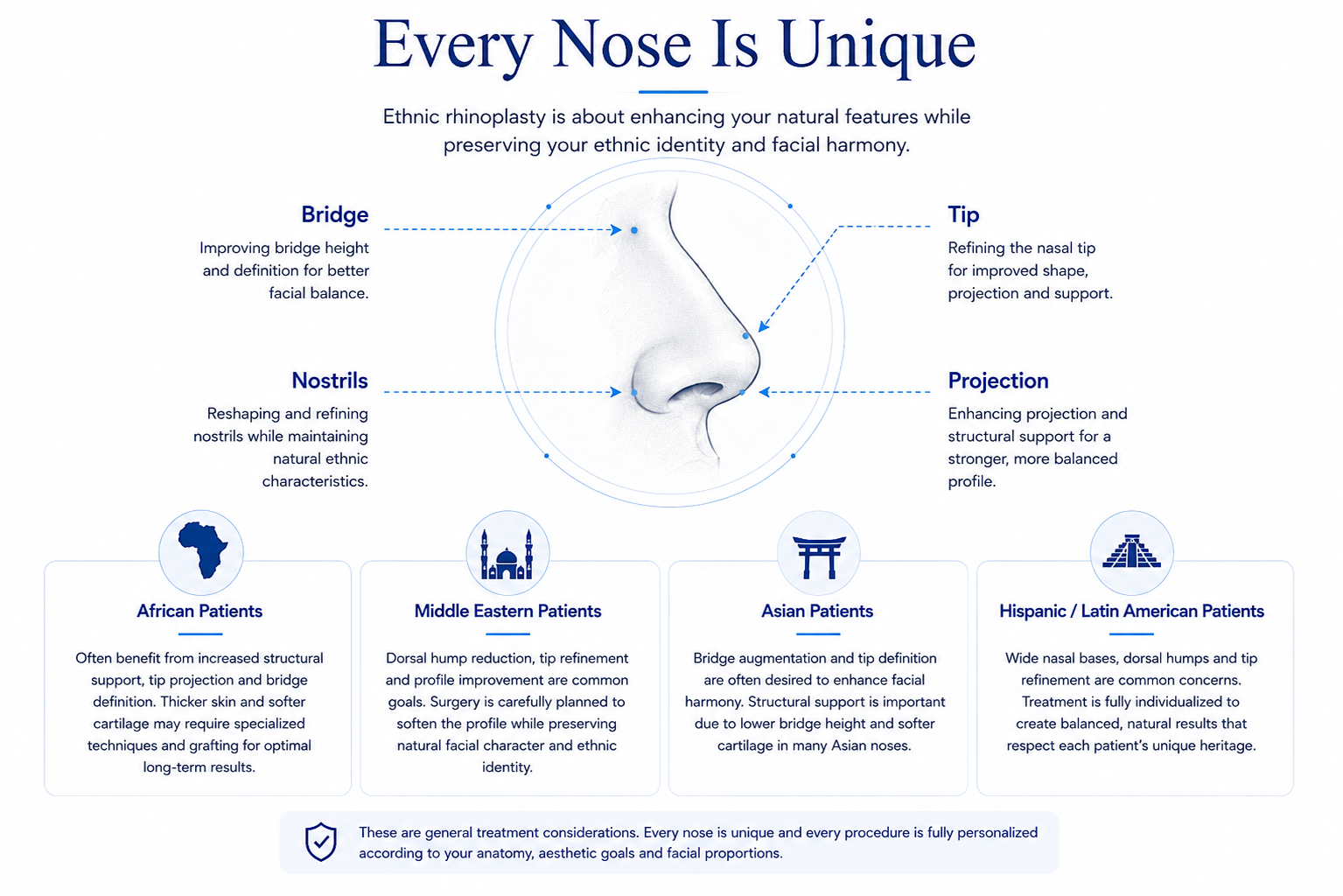
Although every rhinoplasty procedure is fully personalized, different ethnic backgrounds often present unique anatomical characteristics that influence surgical planning. Understanding these differences helps create results that feel balanced, natural, and respectful of each patient’s identity.
African Rhinoplasty
African rhinoplasty is designed to enhance nasal definition while preserving the patient’s natural ethnic features. Common goals include increasing bridge projection, refining the nasal tip, improving structural support, and reducing nostril width when appropriate.
Patients of African heritage often have thicker skin and softer cartilage, making careful surgical planning essential. Cartilage grafting may be recommended to strengthen the nasal framework and provide long-term support while maintaining a natural appearance.
The objective is not to create a smaller “Western” nose, but to achieve greater facial harmony while respecting the patient’s unique identity.
Middle Eastern Rhinoplasty
Middle Eastern rhinoplasty commonly focuses on reducing a prominent dorsal hump, refining the nasal tip, and improving overall nasal proportions while preserving strong facial character.
Many patients have thicker skin combined with a high bridge or a drooping tip. Surgery is carefully planned to soften the profile without over-reducing the nose or compromising natural facial balance.
Functional concerns such as a deviated septum or breathing difficulties can often be corrected during the same procedure.
Asian Rhinoplasty
Asian rhinoplasty often focuses on increasing bridge height, improving tip projection, and enhancing facial balance while maintaining natural Asian facial characteristics.
Many Asian patients have a lower nasal bridge and softer cartilage, making structural support particularly important. Depending on the patient’s anatomy, cartilage grafts may be used to create improved projection and long-term stability.
Every treatment plan is customized to produce subtle, elegant improvements rather than dramatic changes.
Hispanic & Latin American Rhinoplasty
Patients of Hispanic and Latin American heritage often have many different nasal shapes due to diverse genetics. Treatment planning therefore focuses on the individual’s anatomy rather than ethnicity alone.
Common goals include refining the nasal tip, reducing a dorsal hump, and improving symmetry. They also include better facial harmony while preserving natural ethnic identity.
The emphasis is always on achieving results that look authentic, balanced, and proportional to the rest of the face.
Ethnic Rhinoplasty Techniques
Open Ethnic Rhinoplasty
Often recommended for complex cases requiring structural modifications or cartilage grafting.
Piezo Rhinoplasty
Piezo Rhinoplasty uses ultrasonic technology for highly precise bone reshaping while minimizing trauma to surrounding tissues.
Cartilage Grafting
Depending on the patient’s anatomy, cartilage may come from the septum,rib or ear. It can improve long-term support, projection, and stability.
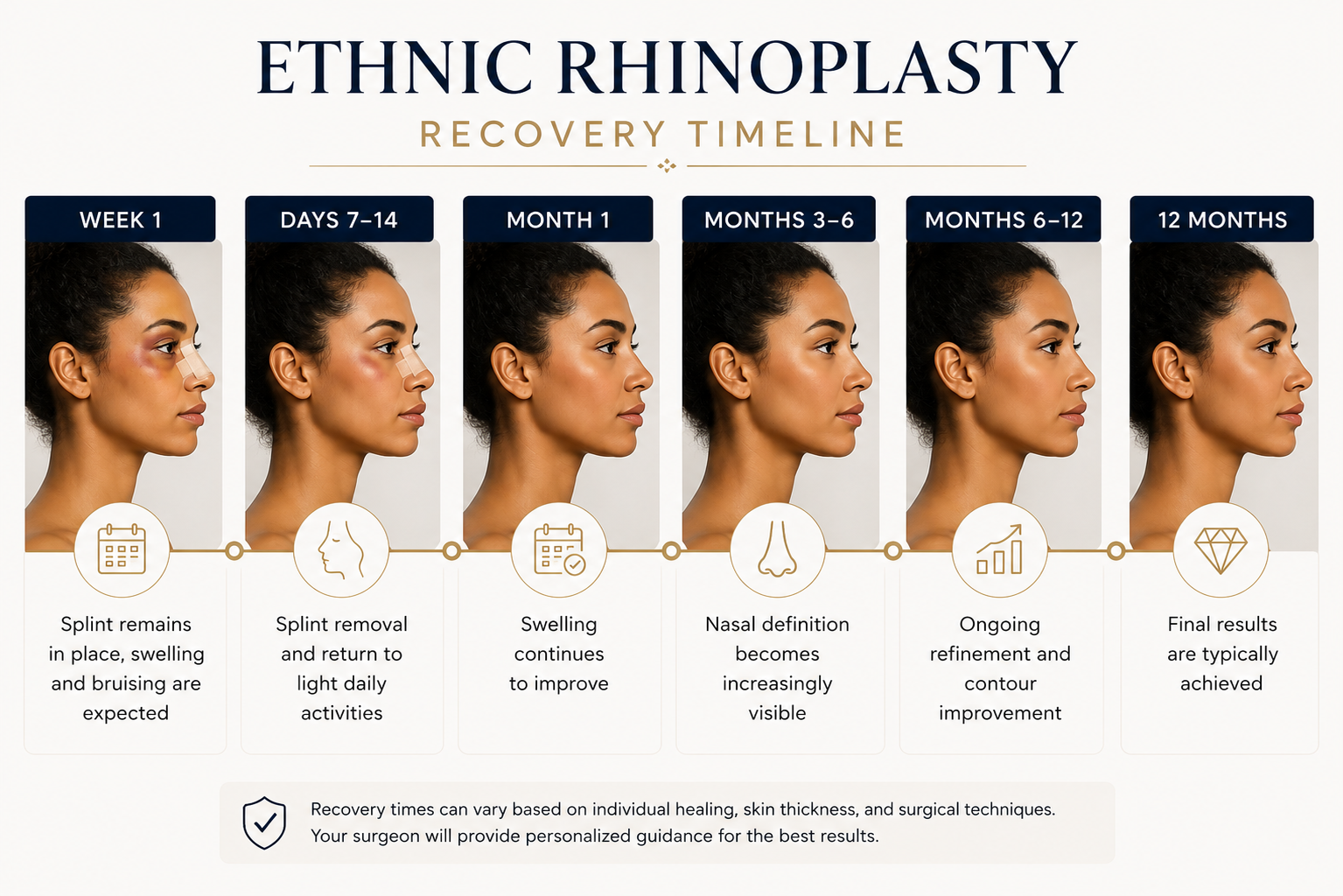
Ethnic Rhinoplasty Recovery Timeline
Timeline | Recovery |
Week 1 | Splint remains in place, swelling and bruising are expected |
Days 7–14 | Splint removal and return to light daily activities |
Month 1 | Swelling continues to improve |
Months 3–6 | Nasal definition becomes increasingly visible |
Months 6–12 | Ongoing refinement and contour improvement |
12 Months | Final results are typically achieved |
Ethnic Rhinoplasty Before and After Results
Successful ethnic rhinoplasty before and after results should demonstrate:
- Natural-looking refinement
- Better facial harmony
- Improved symmetry
- Stronger nasal support
- Preserved ethnic identity
The best results are often those that appear subtle, balanced, and never over-operated.
Ethnic Rhinoplasty Cost in Turkey
The cost of ethnic rhinoplasty in Turkey depends on several factors. These include the procedure’s complexity, cartilage graft needs, the surgical technique, and your treatment plan.
Procedure | Estimated Price |
Ethnic Rhinoplasty | Starting from €5,000 |
Final pricing is determined after your consultation and treatment assessment.
Frequently Asked Questions
Ethnic rhinoplasty is a specialized nose reshaping procedure. It improves the nose’s appearance and function. It also preserves the patient’s natural ethnic features and facial identity. The goal is refinement not westernization.
Ethnic rhinoplasty may suit patients of African, Middle Eastern, Asian, Hispanic, Latin American, or mixed backgrounds. It can improve the nose’s appearance or function while preserving unique facial features.
Yes. Ethnic rhinoplasty requires a personalized surgical approach that considers differences in skin thickness, cartilage strength, nasal bridge height, nostril shape, and facial proportions. The surgical plan is tailored to each patient’s anatomy rather than following a standard aesthetic template.
No. A successful ethnic rhinoplasty enhances facial harmony while preserving the features that reflect your heritage. The objective is to create natural-looking improvements without erasing your ethnic identity.
Yes. Modern ethnic rhinoplasty in Turkey focuses on subtle refinement and facial balance. The goal is to create results that complement your face rather than making your nose look artificial or over-operated.
No. Cartilage grafts are only recommended when additional structural support or projection is needed. Many patients achieve excellent results without grafting.
If cartilage grafting is required, cartilage is usually taken from the nasal septum. In more complex procedures, ear cartilage or rib cartilage may also be used depending on your anatomy and treatment goals.
Yes. Patients with thicker skin may experience a longer healing process, particularly around the nasal tip. Experienced surgeons adjust their techniques accordingly to achieve well-defined and natural-looking results.
Yes. Alar base reduction can be performed to narrow wide nostrils when appropriate. The procedure is carefully planned to maintain natural facial proportions and preserve ethnic characteristics.
Absolutely. If you have functional concerns such as a deviated septum or nasal obstruction, cosmetic improvements can often be combined with procedures that improve breathing.
Most patients return to normal daily activities within 7–14 days. Swelling continues to improve over several months, while final results usually become visible after 12 months.
Although the nose changes significantly during the first few months, final refinement typically occurs between 9 and 12 months, particularly in patients with thicker skin.
Turkey is a top destination for ethnic rhinoplasty.
This is due to skilled surgeons, modern techniques, accredited hospitals, and strong support for international patients.
Yes. If you have breathing problems due to a deviated septum, septoplasty can often be done in the same surgery. This can improve both nasal function and appearance.
The choice depends on your anatomy and surgical goals. Patients requiring structural changes or cartilage grafting often benefit from an open rhinoplasty, while selected cases may be suitable for a closed rhinoplasty approach.
Yes. Ethnic rhinoplasty is suitable for both men and women. Surgical planning differs according to facial proportions, aesthetic goals, and the desire to maintain masculine or feminine nasal characteristics.
Ethnic rhinoplasty requires a thorough understanding of diverse nasal anatomies and facial aesthetics. Choosing a surgeon experienced in treating patients from different ethnic backgrounds helps achieve balanced, natural-looking results while preserving your unique identity.
