
Table of Contents
When it comes to hair transplants, there is a massive misconception that “hair is just hair.” Many clinics use a one-size-fits-all approach, assuming that the exact same technique used for straight hair will work for tightly coiled or curly hair.
But if you have Afro-textured or curly hair, you already know your hair behaves differently. What you might not know is that it behaves completely differently beneath the surface of the skin, too.
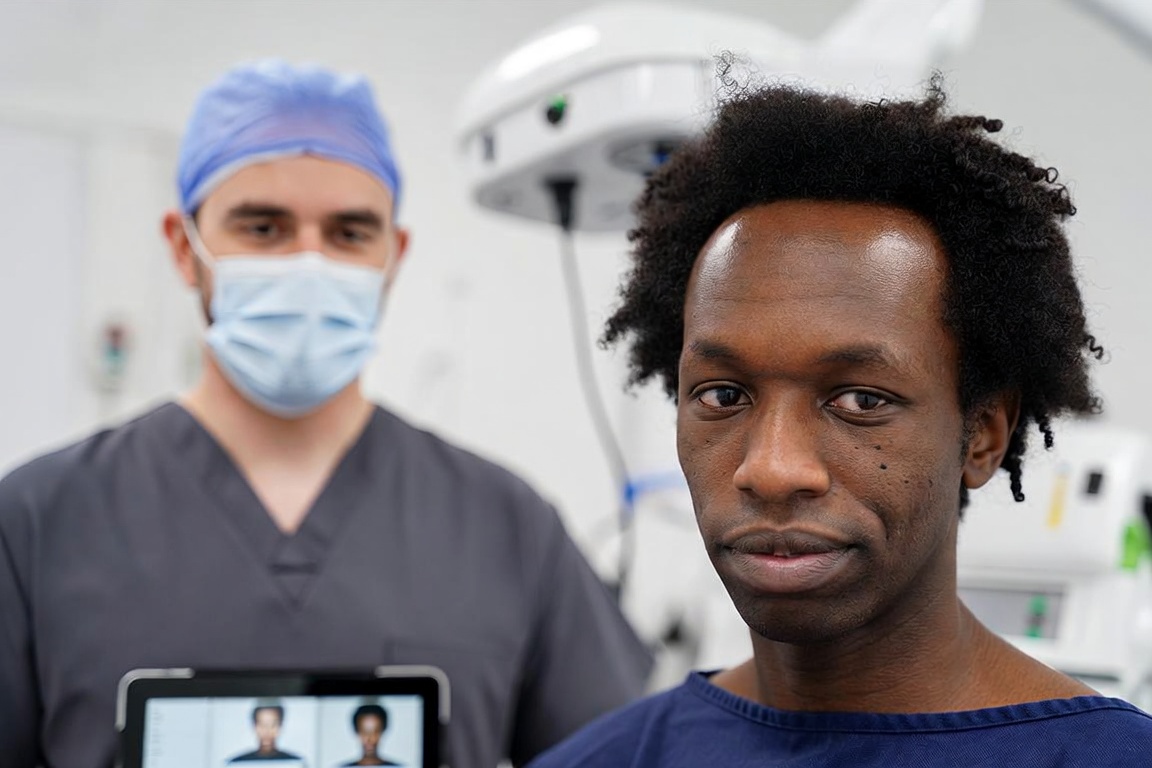
An Afro hair transplant is one of the most delicate and complex procedures in modern hair restoration. It demands a high level of specialized expertise, modified tools, and an artistic eye. Here is exactly why curly and Afro hair requires a specialized approach—and why choosing the right clinic makes all the difference.
The Subterranean Challenge: The C-Shape Follicle
With straight hair, the hair follicle grows relatively straight down into the scalp. A surgeon can easily align their extraction tool (punch) with the visible hair shaft and harvest the root safely.
Afro-textured hair is entirely different. It doesn’t just curl on the outside; the follicle itself curves into a C-shape or helical spiral underneath the skin.
Straight Hair Follicle: (Straight down, easy to extract)
Afro/Curly Follicle: (Curved under the skin, easy to damage)
If an inexperienced surgeon uses a standard, straight punch tool and presses down blindly, they will cut right through the middle of that curved root. This is called transection (accidental graft damage). With conventional techniques, transection rates for Afro hair can skyrocket up to 30% to 80%—meaning the hair is destroyed before it even leaves your head.
The Expert Solution: Specialized surgeons use modified, flared, or curved punches (typically 0.7mm to 0.9mm) and execute manual, skin-responsive extraction. They don’t just push; they adjust the angle of entry to follow the follicle’s hidden subterranean curve, dropping transection rates to under 5%.
The Artistic Hairline: Sharp Geometry vs. Natural Swirls
Hairline design for Afro and curly hair requires a completely different artistic blueprint compared to Caucasian or Asian hair types.
- For Men (The Sharp Finish): Many Black male patients prefer a more geometric, defined, and linear hairline with sharp temporal points (often mirroring a fresh line-up from a barbershop). A specialized surgeon knows how to plant the grafts closely and angularly to support this crisp aesthetic without making it look unnatural.
- The Growth Angle: Curly hair naturally grows at an acute angle to the scalp. If the grafts are implanted too “flat” or at the wrong angle, the hair will grow out looking chaotic or wild. The surgeon must meticulously mimic the natural swirl and direction of your native hair pattern.
The Volume Advantage (The Good News!)
While the extraction process is much harder, Afro-textured hair has a massive biological superpower when it comes to the final result: Visual Density.
Because curly and coily hair expands and locks together as it grows, it covers significantly more surface area on the scalp than straight hair. A single curly graft provides the visual coverage of two or three straight hairs. This means a skilled surgeon can often achieve an incredibly full, dense look using fewer total grafts, preserving your precious donor area for the future.
Specific Medical Considerations: Keloids and Traction Alopecia
Expertise in Afro hair isn’t just about the surgery day; it’s about understanding the unique medical background of textured hair.
- Keloid Scarring Risk: Individuals of African descent have a higher genetic predisposition (ranging from 4% to 16%) to forming keloids (thick, raised scars). An expert clinic will thoroughly evaluate your skin history and use ultra-precise, low-trauma micro-blades or DHI (Direct Hair Implantation) pens to minimize scarring.
- Traction Alopecia in Women: Women with Afro-textured hair frequently experience hair loss along the hairline and temples due to years of tight braids, weaves, or chemical relaxers. This requires a dedicated approach that focuses on hairline softening and reconstruction rather than aggressive global density.
The Verdict: Don't Compromise on Your Coils
If a clinic tells you that an Afro hair transplant is “just the same as any other transplant,” consider it a red flag.
To achieve a high graft survival rate (which sits at a proud 85% to 95% in experienced hands) and a natural look, you need a team that respects the biology of the curl. At Novera, we don’t use generic protocols. Our board-certified surgeons are deeply experienced in multicultural hair restoration, utilizing specialized curved micro-tools designed specifically for coily and texturized structures.
Your crown deserves expert hands. Reach out to the Novera team today for a completely free, personalized online consultation!
Medical Disclaimer
This article is intended for educational purposes only and should not replace professional medical advice. Hair transplant outcomes, longevity, and long-term maintenance vary depending on individual factors such as genetics, donor hair quality, age, overall health, and ongoing hair loss progression. Always consult a qualified hair restoration specialist for a personalized evaluation and treatment plan.
Medical Sources & References
- International Society of Hair Restoration Surgery (ISHRS)
Hair Restoration Patient Resources
https://ishrs.org - American Hair Loss Association (AHLA)
Hair Loss & Hair Transplant Information
https://www.americanhairloss.org - American Academy of Dermatology (AAD)
Hair Loss: Diagnosis and Treatment
https://www.aad.org - National Health Service (NHS)
Hair Loss Overview
https://www.nhs.uk - European Hair Research Society (EHRS)
Hair Research and Clinical Guidance
https://ehrs.org