
Table of Contents
- Why Is Hairline Design So Important?
- What Makes a Natural Hairline?
- Factors That Influence Hairline Design
- Age
- Facial Structure
- Hair Characteristics
- Degree of Hair Loss
- Types of Hairline Designs
- Mature Hairline
- Straight Hairline
- Receding Hairline
- Female Hairline Design
- How Many Grafts Are Needed for Hairline Restoration?
- Which Technique Is Best for Hairline Restoration?
- DHI Hair Transplant
- FUE Hair Transplant
- Common Hairline Design Mistakes
- Can a Poor Hairline Be Corrected?
- Hairline Design Guide: Final Thoughts
- Frequently Asked Questions
When considering a hair transplant, many patients focus primarily on density. However, one of the most important factors in achieving a successful result is actually the hairline itself.
A well-designed hairline can create a youthful, balanced, and natural appearance. In contrast, an unnatural hairline can make even a technically successful procedure look artificial.
This is why hairline design is considered both a science and an art.
In this guide, we’ll explain how specialists create natural-looking hairlines and what factors influence the final design.
Why Is Hairline Design So Important?
The hairline frames the face.
Even small adjustments to its shape, height, or density can dramatically change a person’s appearance.
A successful hairline should:
- Look natural from every angle
- Complement facial proportions
- Age naturally over time
- Match existing hair characteristics
- Preserve donor hair for future needs
Creating a natural-looking hairline requires careful planning and extensive experience.
What Makes a Natural Hairline?
Natural hairlines are rarely perfectly straight.
In reality, natural hairlines contain subtle irregularities and variations.
Characteristics of a natural hairline include:
- Soft transitions
- Slight asymmetry
- Irregular follicle placement
- Gradual density changes
- Appropriate age-related positioning
The goal is to recreate the appearance of naturally growing hair rather than drawing an artificial line across the forehead.
Factors That Influence Hairline Design
Every patient is unique.
Specialists evaluate several factors before designing a hairline.
Age
Patient age plays a major role.
Very low hairlines may appear attractive initially but often look unnatural as patients age.
For younger patients, surgeons usually create slightly conservative hairlines to ensure long-term naturalness.
Facial Structure
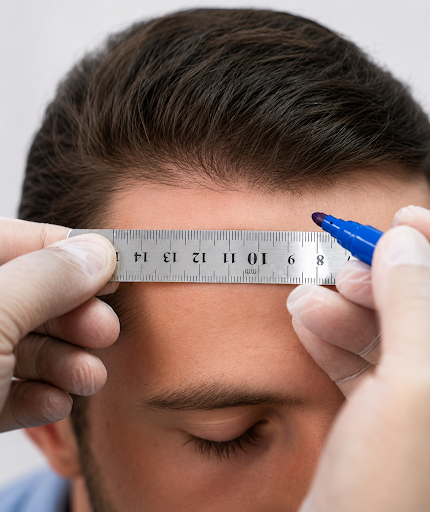
Facial proportions strongly influence ideal hairline placement.
Specialists assess:
Forehead height
Face shape
Brow position
Facial symmetry
The objective is to achieve harmony between the hairline and facial features.
Hair Characteristics
Hair quality significantly affects final appearance.
Important considerations include:
Hair thickness
Curl pattern
Hair color
Hair texture
Donor density
Curly and thick hair generally creates greater visual coverage than fine, straight hair.
Degree of Hair Loss
Current and future hair loss patterns must be considered.
Long-term planning helps ensure the hairline remains natural even if additional hair loss occurs.
Types of Hairline Designs
Hairline design varies according to individual goals and facial characteristics.
Mature Hairline
A mature hairline sits slightly higher than a youthful hairline.
This design often appears more natural in adult men.
Straight Hairline
Straight hairlines are typically requested by younger patients.
However, excessive straightness may create an artificial appearance.
Receding Hairline
Some patients prefer subtle temple recession to maintain a mature, masculine appearance.
Female Hairline Design
Female hairlines usually differ significantly from male designs.
Women often prefer:
Softer contours
Rounded corners
Lower placement
How Many Grafts Are Needed for Hairline Restoration?
The number of grafts required depends on:
- Hairline shape
- Desired density
- Existing hair
- Temple recession severity
Approximate graft requirements:
Treatment Area | Typical Grafts |
Hairline Refinement | 1,000–1,500 |
Moderate Hairline Restoration | 1,500–2,500 |
Extensive Frontal Restoration | 2,500–3,500 |
A detailed consultation is necessary to determine exact requirements.
Which Technique Is Best for Hairline Restoration?
Both FUE and DHI can produce outstanding hairline results.
DHI Hair Transplant
DHI allows precise control over:
Angle
Direction
Depth
Density
For this reason, DHI is frequently preferred for detailed frontal hairline work.
FUE Hair Transplant
FUE also produces excellent results, particularly in patients requiring larger sessions.
The best technique depends on the individual case rather than personal preference alone.
Common Hairline Design Mistakes
Unfortunately, poor planning may lead to unnatural results.
Common mistakes include:
- Hairline placed too low
- Excessively straight design
- Inappropriate density distribution
- Ignoring future hair loss
- Overharvesting donor hair
Selecting an experienced medical team significantly reduces these risks.
Can a Poor Hairline Be Corrected?
Yes.
Hairline correction procedures can improve previously unsatisfactory results.
Correction strategies may include:
- Hairline redesign
- Additional graft placement
- Density enhancement
- Scar camouflage
Revision procedures require careful planning and should be performed by experienced specialists.
Hairline Design Guide: Final Thoughts
Hairline design is one of the most important aspects of successful hair transplantation.
A natural-looking hairline should complement facial features, age gracefully, and preserve long-term treatment options.
Because every patient is unique, personalized planning remains essential.
Consulting an experienced hair restoration specialist is the best way to achieve natural, long-lasting results.
Frequently Asked Questions
What makes a hairline look natural?
Natural hairlines feature soft irregularities, gradual density transitions, and age-appropriate positioning.
How low should a hair transplant hairline be?
Hairline placement should be individualized according to age, facial proportions, and future hair loss risk.
Is DHI better for hairline restoration?
DHI offers excellent precision and is frequently used for detailed hairline work, although FUE can also achieve outstanding results.
Can an unnatural hairline be fixed?
Yes. Revision procedures can often improve or redesign unnatural hairlines.
How many grafts are needed for a hairline transplant?
Most hairline procedures require approximately 1,000 to 2,500 grafts, depending on the extent of restoration.
Medical Disclaimer
This article is intended for educational purposes only and should not replace professional medical advice. Hair transplant outcomes, longevity, and long-term maintenance vary depending on individual factors such as genetics, donor hair quality, age, overall health, and ongoing hair loss progression. Always consult a qualified hair restoration specialist for a personalized evaluation and treatment plan.
Medical Sources & References
- International Society of Hair Restoration Surgery (ISHRS)
Hair Restoration Patient Resources
https://ishrs.org - American Hair Loss Association (AHLA)
Hair Loss & Hair Transplant Information
https://www.americanhairloss.org - American Academy of Dermatology (AAD)
Hair Loss: Diagnosis and Treatment
https://www.aad.org - National Health Service (NHS)
Hair Loss Overview
https://www.nhs.uk - European Hair Research Society (EHRS)
Hair Research and Clinical Guidance
https://ehrs.org