
Table of Contents
- What Is the Norwood Scale?
- What Causes Male Pattern Baldness?
- Norwood Stage 1
- Norwood Stage 2
- Norwood Stage 3
- Norwood Stage 4
- Norwood Stage 5
- Norwood Stage 6
- Norwood Stage 7
- Can Hair Loss Skip Stages?
- Why Is the Norwood Scale Important for Hair Transplantation?
- Can Women Use the Norwood Scale?
- Understanding the Norwood Scale: Final Thoughts
- Frequently Asked Questions
If you’ve started researching hair loss treatments, you’ve probably come across the term Norwood Scale.
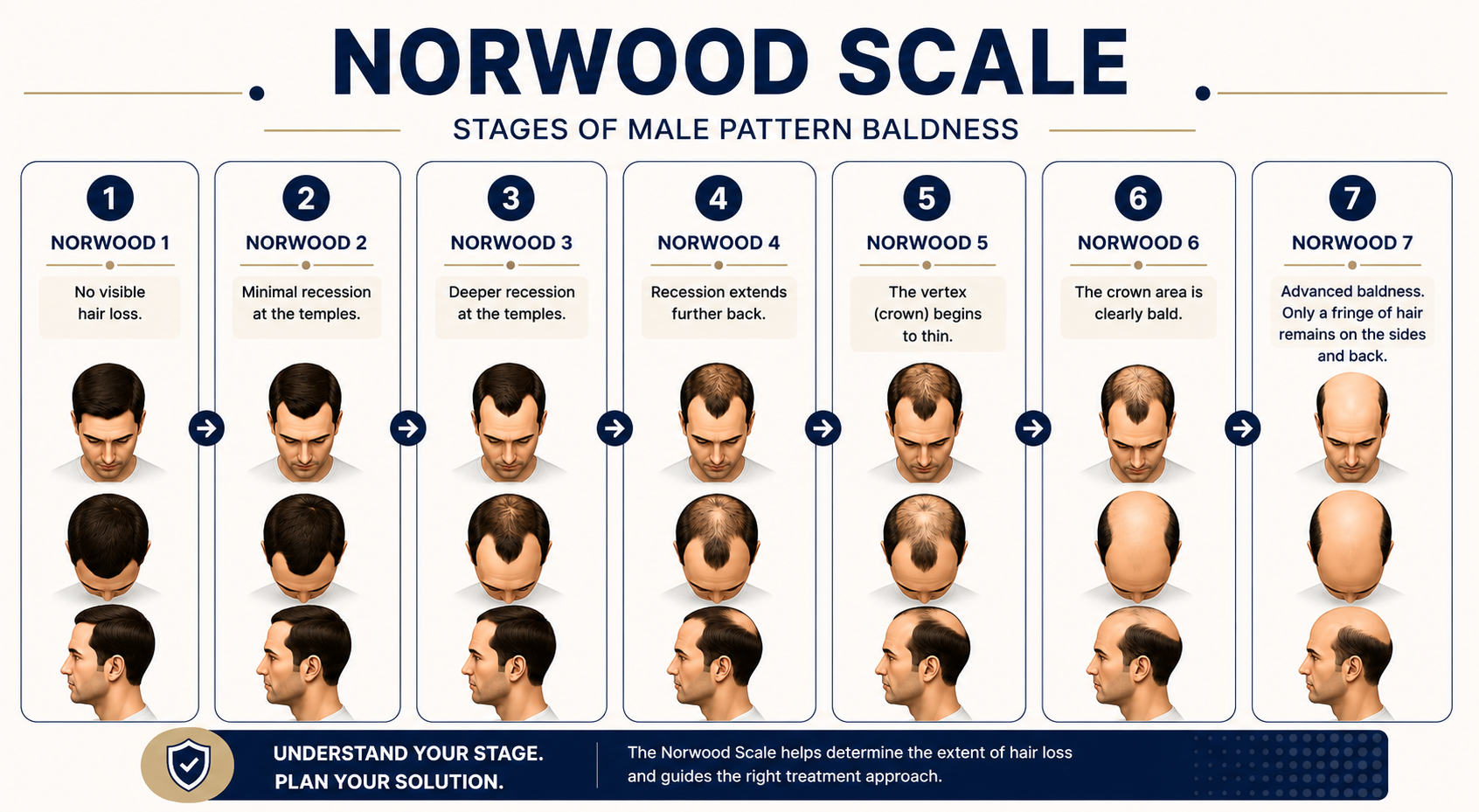
The Norwood Scale, also known as the Hamilton-Norwood Scale, is the most widely used system for classifying male pattern baldness. It helps doctors assess the severity of hair loss, estimate future progression, and determine the most appropriate treatment plan.
Understanding your stage of hair loss is essential whether you’re considering medication, preventive treatments, or hair transplantation.
In this guide, we’ll explain each stage of the Norwood Scale and discuss available treatment options.
What Is the Norwood Scale?
The Norwood Scale is a classification system used to measure the progression of male pattern baldness (androgenetic alopecia).
Originally developed by Dr. James Hamilton and later expanded by Dr. O’Tar Norwood, the scale categorizes hair loss into seven distinct stages.
The system allows specialists to:
- Assess the severity of hair loss
- Predict future hair loss progression
- Estimate graft requirements
- Plan treatment strategies
- Set realistic expectations
Because male pattern baldness usually progresses gradually, understanding your current stage can help you make more informed treatment decisions.
What Causes Male Pattern Baldness?
Male pattern baldness is primarily caused by a combination of:
- Genetics
- Hormones
- Aging
The hormone most closely associated with hair loss is DHT (Dihydrotestosterone).
In genetically susceptible individuals, DHT gradually causes hair follicles to shrink, producing thinner, weaker hairs until growth eventually stops.
Norwood Stage 1
Description
Norwood Stage 1 represents little to no visible hair loss.
The hairline remains youthful, and there is minimal recession around the temples.
Typical Characteristics
Full hair density
No significant recession
Stable hairline
Treatment Approach
At this stage, treatment is usually not necessary.
However, patients with a family history of hair loss may consider preventive measures and regular monitoring.
Norwood Stage 2
Description
Norwood Stage 2 is characterized by mild recession at the temples.
Although this stage may still be considered a mature hairline rather than true baldness, some men begin noticing subtle changes.
Typical Characteristics
Slight temple recession
Minimal hairline changes
No crown thinning
Treatment Approach
Preventive therapies may help slow future progression.
Early intervention can often preserve existing hair.
Norwood Stage 3
Description
Norwood Stage 3 is considered the first clinically significant stage of male pattern baldness.
Hairline recession becomes more pronounced, particularly around the temples.
Typical Characteristics
Deep temple recession
Noticeable “M-shaped” hairline
Early frontal hair loss
Typical Graft Requirement
1,500–2,500 grafts
Treatment Options
Medical therapy
PRP therapy
Hair transplantation
Many patients begin considering hair transplant procedures during this stage.
Norwood Stage 4
Description
At Norwood Stage 4, hair loss becomes more obvious.
Patients typically experience frontal recession along with noticeable thinning at the crown.
Typical Characteristics
Significant frontal hair loss
Crown thinning
Reduced density across the top of the scalp
Typical Graft Requirement
2,500–3,500 grafts
Treatment Options
Hair transplantation is commonly recommended, particularly when hair loss has stabilized.
Norwood Stage 5
Description
At Norwood Stage 5, the bridge of hair separating the frontal and crown areas becomes significantly narrower.
Hair loss becomes much more extensive.
Typical Characteristics
Extensive frontal recession
Enlarged crown baldness
Reduced scalp coverage
Typical Graft Requirement
3,500–4,500 grafts
Treatment Options
Comprehensive restoration planning is often required.
Norwood Stage 6
Description
Norwood Stage 6 represents advanced baldness.
The frontal and crown regions merge, leaving only limited hair across the top of the scalp.
Typical Characteristics
Large bald area
Minimal separation between crown and frontal scalp
Extensive hair loss
Typical Graft Requirement
4,500–6,000+ grafts
Treatment Options
Hair transplantation remains possible if donor reserves are sufficient.
Long-term planning becomes extremely important.
Norwood Stage 7
Description
Norwood Stage 7 is the most advanced stage of male pattern baldness.
Only a horseshoe-shaped band of hair remains around the sides and back of the scalp.
Typical Characteristics
Extensive scalp baldness
Limited donor availability
Minimal remaining top scalp hair
Typical Graft Requirement
6,000+ grafts (often multiple sessions)
Treatment Options
Patients may still benefit from hair transplantation, although expectations should remain realistic.
Can Hair Loss Skip Stages?
Not usually.
Most men progress gradually through the Norwood stages over many years.
However, the rate of progression varies significantly between individuals.
Some men experience slow progression, while others may lose hair rapidly.
Why Is the Norwood Scale Important for Hair Transplantation?
The Norwood Scale helps specialists determine:
- Whether a patient is a good candidate
- Estimated graft requirements
- Donor area management
- Hairline design strategy
- Long-term treatment planning
Accurate assessment helps ensure natural-looking, sustainable results.
Can Women Use the Norwood Scale?
The Norwood Scale was developed specifically for male pattern baldness.
Female hair loss is usually classified using the Ludwig Scale, which evaluates diffuse thinning patterns commonly seen in women.
Understanding the Norwood Scale: Final Thoughts
Understanding your Norwood stage is one of the first steps in managing hair loss effectively.
Whether you are considering preventive treatment, medical therapy, or hair transplantation, knowing the extent of your hair loss allows for better planning and more realistic expectations.
A consultation with an experienced hair restoration specialist remains the best way to determine your current stage and discuss appropriate treatment options.
Frequently Asked Questions
What is the Norwood Scale?
The Norwood Scale is the most widely used classification system for male pattern baldness.
What is the worst Norwood stage?
Norwood Stage 7 represents the most advanced form of male pattern baldness.
Can Norwood 3 be reversed?
Early intervention and medical therapies may slow progression and improve appearance, although outcomes vary.
How many grafts does Norwood 6 require?
Patients with Norwood 6 hair loss often require between 4,500 and 6,000+ grafts.
Is the Norwood Scale accurate?
Yes. It is the internationally recognized standard for assessing male pattern baldness.
Medical Disclaimer
This article is intended for educational purposes only and should not be considered medical advice. Hair loss patterns, treatment recommendations, graft requirements, and expected outcomes vary depending on each individual’s genetics, age, donor hair availability, and overall health. Always consult a qualified hair restoration specialist for a personalized assessment and treatment plan before making decisions about hair loss management.
Medical Sources & References
- International Society of Hair Restoration Surgery (ISHRS)
Hair Restoration Patient Resources
https://ishrs.org - American Hair Loss Association (AHLA)
Hair Loss & Hair Transplant Information
https://www.americanhairloss.org - American Academy of Dermatology (AAD)
Hair Loss: Diagnosis and Treatment
https://www.aad.org - National Health Service (NHS)
Hair Loss Overview
https://www.nhs.uk - European Hair Research Society (EHRS)
Hair Research and Clinical Guidance
https://ehrs.org