

Table of Contents
- Before Considering Revision Rhinoplasty
-Setting Realistic Expectations
-Understanding Your Revision Goals
- Common Reasons for Revision Rhinoplasty
-Cosmetic Concerns
-Functional Problems & Breathing Difficulties
- When Is the Right Time for Revision Surgery?
-The 12-Month Golden Rule
-Why Waiting Matters
- Why Revision Rhinoplasty Is More Complex Than Primary Rhinoplasty
-Scar Tissue Challenges
-Cartilage Grafting (Ear vs. Rib)
- Frequently Asked Questions
-When should I consider revision rhinoplasty?
-Can swelling make my nose look uneven?
-What if I have breathing problems?
-What if my previous revision failed?
-Can revision surgery correct both appearance and function?
Revision Rhinoplasty in Turkey: When to Get It, Who to Trust, and Why It’s the Ultimate Surgical Art
Having a nose job is a major life event, both physically and emotionally. You wait weeks for the splints to come off and months for the swelling to go down, constantly hoping to see that perfect balance in the mirror.
But what happens if the final result isn’t what you expected? What if your nose looks asymmetrical, artificial, or worse—what if you can suddenly no longer breathe properly?
First, take a deep breath. You are not alone, and it can be fixed.
This corrective process is called Revision Rhinoplasty (a secondary nose job). Because a revision is vastly different from a first-time surgery, it requires a completely different level of strategic planning, structural mastery, and patient psychology. Let’s dive deep into everything you need to know about fixing a previous nose job.
Prior to the Journey: Thinking Clearly About Revision Goals
Before booking a flight for a second surgery, it is vital to check in with your expectations. Often, dissatisfaction doesn’t stem from a surgeon’s lack of skill, but from a wide gap between what was expected and what is anatomically possible.
Setting Achievable Goals
- Open Communication: You must articulate your exact aspirations to your surgeon while understanding your unique structural boundaries.
- The Reality Check: Reviewing before-and-after photos of previous revision patients can offer a realistic glimpse into what can be achieved.
- A Crucial Note on Psychology: If your discontent is rooted in unrealistic expectations or deeper body image struggles, seeking guidance from a therapist who specializes in body image issues might prove far more beneficial than rushing into another surgery. A revision should be a mindful decision, not a continuation of unmet desires.
Circumstances That Necessitate a Second Rhinoplasty
Why do people seek a revision? The reasons generally fall into two categories: Cosmetic disappointment and Functional failure. Here are the most common signs that you might need a subsequent procedure:
Structural & Cosmetic Issues:
- Asymmetry & Misalignment: One side of the nose looks completely different, or the nostrils are visibly uneven.
- The “Artificial” Look: The nose looks overly narrowed, pinched, excessively elongated, or completely lacks natural definition (often called a “cookie-cutter” nose).
- Conspicuous Scarring: Elevated or dark scars that mar the aesthetic appeal of the nose, requiring specialized camouflage or revision techniques.
- Under-correction: The initial procedure simply fell short of achieving the envisioned reshaping.
The Functional Crisis: Breathing Difficulties
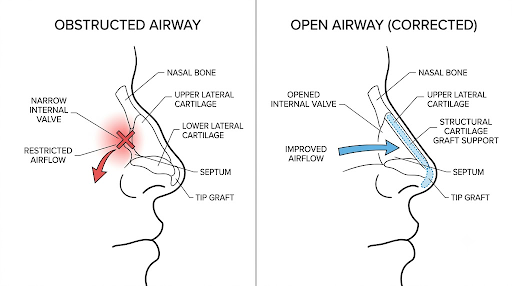
For many, a revision isn’t about looks at all. The primary surgery may have caused internal structural collapse (like a collapsed nasal valve or a worsened deviated septum), severely impairing daily airflow. A secondary surgery transcends aesthetics when it is required to restore your quality of life.
When Should You Decide on a Revision? (The 1-Year Golden Rule)
The absolute most important rule of revision rhinoplasty is mastering the art of waiting.
- The Minimum Wait Time: You must wait at least 12 full months—and up to 18 months for thick-skinned or ethnic profiles—before undergoing a revision.
- The Healing Illusion: During the first year, your nose is undergoing a massive internal remodeling process. What looks like a hard bump or an uneven tip at month 6 might just be uneven fluid retention (edema).
- The Risk of Early Surgery: Inside the nose, the tissues are stiff and heavily scarred in the first several months. Operating on a nose that hasn’t fully stabilized can cause severe tissue tearing, skin damage, and irreversible structural failure. Your tissues need to become soft and healthy again first.
Should You Go Back to Your Original Surgeon?
This is one of the most agonizing dilemmas for patients. The honest answer depends on the scale of the problem and the level of trust you still have.
- Stay with your original doctor if: The issue is incredibly minor (like a tiny, sharp edge of cartilage that needs a quick touch-up) and you still have a strong, trusting bond with your surgeon. Many reputable surgeons will perform minor refinements for just the cost of hospital fees.
- Find a new revision specialist if: The trust has completely broken down, the initial surgeon refuses to acknowledge there is a problem, or the issue is structurally severe (like a severely collapsed bridge).
Why is a Revision So Much More Difficult?
A primary nose job is like building a house on a clean, empty plot of land; a revision is like remodeling a house that was built structurally unsound. The surgeon faces major subterranean obstacles:
- The Minefield of Scar Tissue: The surgeon must meticulously dissect through tough layers of unpredictable scar tissue left behind by the first surgery without damaging the delicate skin overhead.
- The Scarcity of Building Materials: In your first surgery, the doctor likely used up the straight, flat cartilage from your septum.
- The Rib and Ear Graft Solution: To rebuild a collapsed bridge or support an uneven tip, the revision specialist must harvest fresh cartilage from another part of your body—usually your ear (for minor tip work) or your rib (the gold standard for major structural rebuilds).
Selecting the Ideal Surgeon for Your Revision Journey
Because of the sheer complexity of secondary surgeries, choosing your doctor is the most critical decision you will make. During your initial consultation at Novera, we ensure that you:
- Clearly articulate your precise aesthetic and functional objectives.
- Thoroughly discuss your complete medical and surgical history.
- Address specific concerns stemming directly from the previous rhinoplasty.
This deep, transparent dialogue ensures a mutual understanding, laying the perfect groundwork for achieving the safe, satisfying, and beautiful outcome you deserve.
Frequently Asked Questions (FAQ)
How long should I wait before getting a revision rhinoplasty?
You should wait at least 12 months after your primary rhinoplasty before considering revision surgery. This gives internal scars time to mature, tissues to soften, and your nose to reach its final shape. In patients with thicker skin, waiting 12 to 18 months may be recommended.
My nose still looks swollen. Should I consider revision surgery?
Not yet. Swelling can resolve unevenly for up to a year—and sometimes longer in patients with thick skin. If your concerns are mainly related to swelling, it’s usually best to wait until 12 to 15 months before evaluating the final result.
What if I still have breathing problems after rhinoplasty?
If breathing difficulties continue beyond the sixth month, once most internal swelling has subsided, you should schedule an evaluation with an experienced rhinoplasty specialist. If structural issues such as nasal valve collapse are identified, revision surgery may be planned after the one-year healing period.
What if I’m unhappy with the cosmetic result?
If your nose still appears crooked, over-rotated, asymmetrical, or otherwise different from your expectations after 12 months, a revision rhinoplasty consultation can help determine whether these concerns can be safely corrected.
Can revision rhinoplasty fix a crooked nose?
Yes. If your nose remains visibly crooked after complete healing, the underlying cause may be structural asymmetry or uneven bone healing. Revision rhinoplasty can often restore better alignment while preserving both appearance and function.
Can scar tissue affect my final result?
Yes. Internal scar tissue can create irregular contours, pinching, or asymmetry. Once healing is complete—typically between 12 and 18 months—an experienced revision surgeon can carefully address scar tissue and refine the nasal shape.
What if I’ve already had a failed revision rhinoplasty?
Patients who have undergone both a primary and revision procedure may require tertiary rhinoplasty, one of the most technically demanding nasal surgeries. Because tissue quality is more fragile, waiting at least 12 to 18 months and choosing a highly experienced revision specialist is essential.
Can revision surgery correct an uneven nasal tip?
Yes. Mild tip asymmetry is common during the healing process. However, if the nasal tip remains uneven, droopy, or pinched after one year, cartilage grafting using septal or ear cartilage can often restore balance and improve definition.
Can revision rhinoplasty improve both appearance and breathing?
Absolutely. Many revision procedures are designed to address both cosmetic concerns and functional problems at the same time. By rebuilding internal support structures while refining the external appearance, surgeons can improve nasal airflow as well as facial harmony.
When should I schedule a consultation with a revision rhinoplasty specialist?
You don’t have to wait a full year to seek professional advice. Many patients schedule an online consultation around 9 to 10 months after their first surgery. This allows the surgeon to review healing progress, discuss realistic expectations, and prepare a treatment plan if revision surgery becomes appropriate after the one-year mark.
Sources
The information presented in this article is based on internationally recognized medical organizations and peer-reviewed scientific literature.
American Society of Plastic Surgeons (ASPS) – Revision Rhinoplasty & Rhinoplasty Patient Safety
American Academy of Facial Plastic and Reconstructive Surgery (AAFPRS)
International Society of Aesthetic Plastic Surgery (ISAPS)
European Academy of Facial Plastic Surgery (EAFPS)
PubMed – Clinical research on revision rhinoplasty, cartilage grafting, and nasal reconstruction
National Institutes of Health (NIH)
NHS (United Kingdom) – Rhinoplasty Overview