


Ethnic Nose Job in Turkey
Table of Contents
- Introduction: How Much Is an Ethnic Nose Job in Turkey?
- What Is an Ethnic Nose Job?
-Preserving Ethnic Identity
-Structural Differences in Ethnic Noses - What Makes Ethnic Rhinoplasty Different?
-Building Up vs. Taking Away (Augmentation vs. Reduction)
-Managing Thick Skin vs. Thin Skin
-Nostril Refinement (Alar Base Reduction) - The Novera Philosophy: Natural Results That Respect Your Heritage
- Why Choose Turkey for Ethnic Rhinoplasty?
- How Much Does an Ethnic Nose Job Cost in Turkey?
-Cost Comparison: Turkey vs. US & UK
-Factors That Affect the Price - What’s Included in Novera’s All-Inclusive Rhinoplasty Packages?
-Luxury Accommodation
-VIP Airport & Hospital Transfers
-Multilingual Patient Support
-Hospital & Post-Operative Care - Ethnic Rhinoplasty Recovery Timeline
-Days 1–2: Surgery & Hospital Stay
-Day 3: First Check-Up
-Day 7: Cast Removal & Flying Home
-Months 1–18: Long-Term Healing - Frequently Asked Questions
-Will my ethnic nose job look natural?
-Why is ethnic rhinoplasty more expensive?
-When can I wear glasses after surgery? - Start Your Ethnic Rhinoplasty Journey
How Much Is an Ethnic Nose Job in Turkey? Prices, Techniques, and What to Expect
If you are researching rhinoplasty online, you have likely noticed that most search results focus on Caucasian noses—typically reducing a dorsal hump or thinning a bridge. But if you are of African, Asian, Middle Eastern, or Hispanic descent, your facial anatomy, skin thickness, and cartilage structure are beautifully unique.
This is where Ethnic Rhinoplasty comes in. And if you are asking, “How much is an ethnic nose job in Turkey?”, you are looking in the right place. Istanbul has become the global capital for this highly specialized procedure.
Let’s break down the costs, the specialized techniques required, and why a one-size-fits-all approach simply doesn’t work for ethnic profiles.
What Exactly is an Ethnic Nose Job?
An ethnic nose job is a specialized rhinoplasty that reshapes the nose while fully preserving your unique ethnic identity and facial harmony. The goal is never to give an African, Asian, or Middle Eastern patient a generic Caucasian nose—doing so results in an unnatural, artificial look.
Traditional rhinoplasty often focuses on reduction (taking bone and cartilage away). Ethnic rhinoplasty, however, frequently requires structural augmentation (building up the nose).
Structural Differences in Ethnic Noses:
- African & Asian Profiles: Often feature a lower or flatter nasal bridge, wider nostrils (alar base), and a softer, less supported nasal tip. The skin is typically thicker, and the internal cartilage can be quite delicate.
- Middle Eastern & Hispanic Profiles: Frequently present a prominent bridge or hump paired with a drooping or heavy nasal tip that dips down when smiling.
Because of these traits, specialized surgeons often perform cartilage grafting (using small pieces of cartilage from your septum, ear, or rib) to build up a flat bridge or give the tip of the nose structural support.
What is Ethnic Rhinoplasty & How Does It Differ?
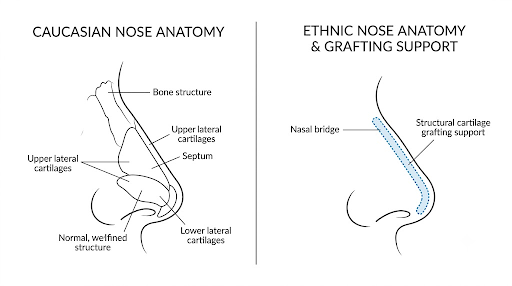
To understand why ethnic rhinoplasty is a distinct medical subspecialty, we have to look at how traditional nose jobs evolved. Historically, traditional rhinoplasty was developed based on Western (Caucasian) facial models. The classic goal was almost always reduction—shaving down a prominent bone hump, narrowing a thin bridge, or pinning up a pointy tip.
If a surgeon applies those exact same “reduction” rules to an Asian, African, or Middle Eastern nose, the results can be disastrous. It can lead to an unnatural, collapsed look, or worse, breathing difficulties.
Here is exactly what makes Ethnic Rhinoplasty completely different from a traditional nose job:
1. Building Up vs. Taking Away (Augmentation vs. Reduction)
While traditional rhinoplasty often focuses on making the nose smaller, ethnic rhinoplasty frequently focuses on structural augmentation.
- For many African and Asian patients, the nasal bridge is naturally flat or low, and the cartilage inside the tip is very soft.
- Instead of shaving anything down, the surgeon must build up the bridge and reinforce the tip using cartilage grafts (harvested from the septum, ear, or rib) to create beautiful definition and height.
2. Managing Thick Skin vs. Thin Skin
This is the hidden challenge that only expert surgeons master. Many ethnic nose types feature thicker, more sebaceous (oily) skin over weak internal cartilage.
- Thin skin easily shrinks and shows the new bone structure beneath it right away.
- Thick skin acts like a heavy blanket; if you just make the cartilage underneath smaller, the thick skin will simply sag, causing a bulbous or “undefined” look.
- An ethnic rhinoplasty specialist creates a stronger, highly defined internal framework so that the thick skin drapes over it perfectly, revealing a sharp, elegant shape.
3. Nostril Refinement (Alar Base Reduction)
Widening or flaring nostrils is a very common trait in certain ethnicities. In a traditional nose job, this is rarely addressed. In ethnic rhinoplasty, the surgeon performs an ultra-precise technique called alar base reduction to gently narrow the nostril base, ensuring the incisions are completely hidden within the natural curves of the nose so no one can tell you had surgery.
Traditional Rhinoplasty: Shaves down bone ➔ Focuses on reduction ➔ Designed for thin skin
Ethnic Rhinoplasty: Builds up structure ➔ Focuses on harmony ➔ Designed for thick skin
The Novera Philosophy:
We don’t believe in “cookie-cutter” or “copy-paste” noses. Ethnic rhinoplasty is not about erasing your heritage or “westernizing” your face. It is about correcting the specific things that bother you—like a drooping tip or a wide base—while keeping the nose in perfect harmony with your natural, beautiful cultural identity.
Why Choose Turkey for Ethnic Rhinoplasty?
Turkey has earned its reputation as the world’s leading destination for rhinoplasty because Turkish surgeons operate on a massively diverse, global patient base every single day.
They are uniquely experienced in multicultural facial anatomy. Furthermore, the world-class, accredited hospitals in Istanbul offer advanced techniques—like Piezo Ultrasonic Rhinoplasty (which uses sound waves instead of traditional hammers and chisels to reshape bone with minimal bruising)—at a fraction of Western costs.
How Much Does an Ethnic Nose Job Cost in Turkey?
In Western countries like the US or UK, an ethnic nose job is considered a highly premium, complex procedure. Prices can easily soar between $9,000 to $25,000 / £8,000 to £15,000, often excluding hospital and anesthesia fees.
In Turkey, thanks to lower operational costs and a favorable exchange rate, you can access top-tier, board-certified facial plastic surgeons for significantly less.
While exact costs depend on whether you need a primary surgery or a complex revision (using rib cartilage), standard price dynamics in Istanbul generally look like this:
|
Region / Country |
Average Cost Range (All-Inclusive) |
|
United States |
$10,000 – $22,000+ |
|
United Kingdom |
£7,500 – £14,000+ |
|
Novera (Istanbul, Turkey) |
€3,000 – €5,500 |
Novera's All-Inclusive Nose Job Packages
We believe your focus should entirely be on your healing, not on logistics. That is why Novera packages everything you need into a seamless, stress-free medical holiday:
- Premium Accommodation: 6 to 7 nights of rest in a luxury 4 or 5-star hotel.
- VIP Transportation: Private, comfortable transfers between the airport, hotel, and hospital.
- Multilingual Support: A personal facilitator from the Novera team who speaks your native language and accompanies you to all medical consultations.
- Post-Op Essentials: All hospital fees, general anesthesia, splints, customized nasal bands, and essential medications.
The Recovery Timeline: What to Expect
Planning your trip means knowing how much time you need to take off work. For an ethnic nose job in Istanbul, you should plan for a 7 to 8-day stay.
- Days 1–2 (The Surgery): The procedure is performed under general anesthesia and takes 2 to 4 hours. You will spend one comfortable night in the hospital for monitoring.
- Day 3 (The Check-up): Internal soft silicone splints (tampons) are gently removed. You are free to enjoy Istanbul at a relaxed pace.
- Day 7 (The Reveal): Your external plastic splint and cast are removed. Your new nasal structure is revealed! The surgeon applies supportive medical tape, and you are cleared to fly home.
- The Healing Journey: While you can safely return to office work within 10 to 14 days, thick ethnic skin holds swelling longer than thin skin. While 80% of the swelling fades in the first month, your final, beautifully defined definition will continue to refine over 12 to 18 months.
Frequently Asked Questions (FAQ)
Will my ethnic nose job look completely natural?
Yes, absolutely. The entire philosophy of modern ethnic rhinoplasty is balance. By respecting your natural facial proportions and ethnic heritage, our surgeons improve the definition of the tip and bridge without erasing what makes your face uniquely yours.
Why is ethnic rhinoplasty more expensive than a standard nose job?
Because it is anatomically more complex. It requires advanced grafting techniques to build structural support into the nose, rather than simply shaving bone down. It demands a surgeon who possesses specific artistic mastery over diverse facial profiles.
When can I wear glasses or sunglasses after surgery?
Because your nasal bones are delicately setting into their new positions, you must avoid resting any weight on the bridge of your nose for at least 2 to 3 months. Your medical team will guide you on using contact lenses or special tape-on alternatives.
Sources
The information presented in this article is based on internationally recognized medical organizations and peer-reviewed scientific literature.
- American Society of Plastic Surgeons (ASPS) – Rhinoplasty (Nose Surgery)
- International Society of Aesthetic Plastic Surgery (ISAPS)
- American Academy of Facial Plastic and Reconstructive Surgery (AAFPRS)
- PubMed – Clinical studies on ethnic rhinoplasty and nasal reconstruction
- National Institutes of Health (NIH)
- NHS (United Kingdom) – Rhinoplasty Overview